.png)
In the high volume paver block manufacturing industry, efficiency on the production line is directly tied to profitability. Every additional step in your manufacturing process adds labor time and material costs. One of the most common questions new and scaling manufacturers ask is: Do I need to apply a mould release agent or oil to rubber paver moulds before pouring the concrete?
The short answer is no. Eliminating the use of release oil for rubber paver moulds is one of the most significant operational advantages of choosing rubber over traditional materials. Here is a breakdown of why you can skip the oil and how it benefits your production line, along with essential rubber mould maintenance tips to extend their lifespan.
When manufacturing wet cast paver blocks, the goal is a seamless demoulding process that leaves the concrete surface flawless. Rubber moulds naturally facilitate this without chemical intervention for two primary reasons. High quality rubber has naturally non porous and non stick properties. Unlike rigid materials that grip the curing cement, wet concrete simply does not bond chemically or physically to the rubber surface. Once the concrete has fully cured, it is ready to be removed without tearing or sticking. Demoulding process relies heavily on flexibility. Because rubber moulds can bend and flex, workers can easily peel the mould away from the cured block. This natural pop out mechanic completely replaces the need for a lubricating barrier.
By bypassing release oils entirely, industrial wet cast block manufacturers can optimize their overhead and increase operational margins. Release agents are a consumable expense. Eliminating this step means less expenditure on raw materials and chemicals that do not directly contribute to the concrete structure's strength or longevity. The savings achieved over an annual production cycle can be re-invested into automated machinery, like a semi-automatic or fully automatic planetary mixer, to scale operations further.
Rubber moulds guarantee an unblemished, glossy finish without the dulling effect that heavy release oil often leaves on the block's surface. With plastic moulds, if too much oil is applied, it pools in the crevices of the mould, leading to air bubbles, honeycombing, and inconsistent curing around the edges. This creates weak spots and aesthetic defects. Rubber eliminates this variable entirely, providing consistent quality batch after batch.
Furthermore, without oil residue, the interlocking joints of the pavers remain perfectly sharp. Sharp edges are crucial for maintaining an even, tight fit during installation. A tight fit ensures the longevity of the paved surface and prevents weed growth and water seepage.
This efficiency is paramount for operations pushing out thousands of units per shift. The labor previously dedicated to brushing or spraying moulds can be reallocated to quality control, material loading, or operating the vibro press. It is a direct labor-saving measure that translates immediately to the bottom line.
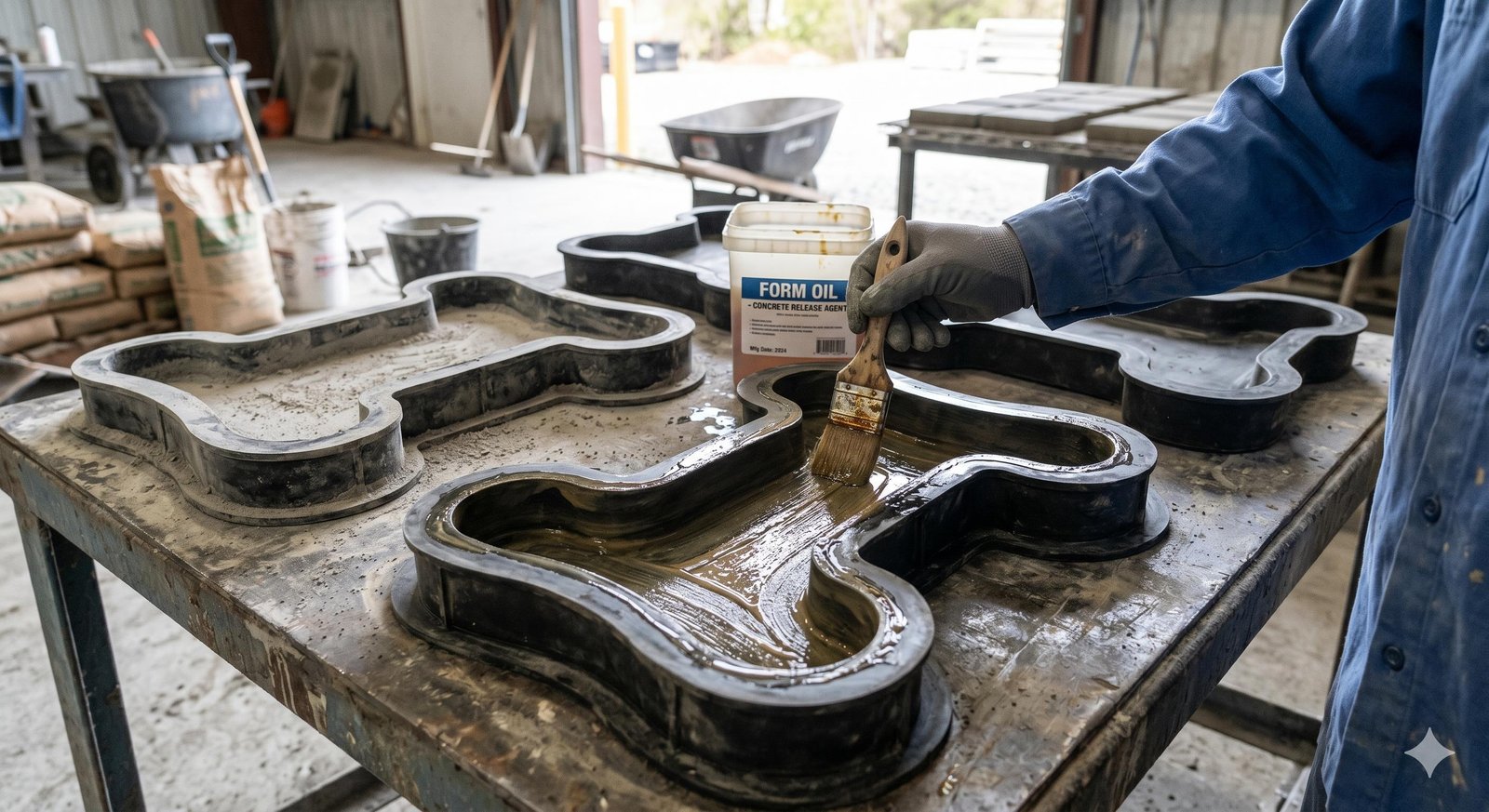
Understanding the chemistry behind the concrete mix is also important. A standard M30 to M40 grade concrete used for paver blocks requires an optimal water-cement ratio of around 0.35 to 0.40. When you introduce external chemicals like release oils, you risk altering the hydration process at the very surface of the block. This can lead to a weaker "skin" on the paver, making it more susceptible to abrasion and weathering over time. By using pristine rubber moulds, the hydration process remains undisturbed, resulting in maximum surface hardness and durability.
When scaling up a paver block manufacturing business, every fraction of a rupee saved per block exponentially increases your return on investment (ROI). Consider a fully automatic plant producing up to 10,000 blocks a day. If you were using plastic moulds and applying release oil, the cost of the oil plus the manual labor to apply it would eat significantly into your daily profits. Rubber moulds, by their very nature, allow manufacturers to completely bypass this bottleneck. They offer an elegant, physics-based solution to what used to be a chemical dependency.
In addition to cost savings, environmental considerations are becoming increasingly important in modern manufacturing. Release oils are often petroleum-based. Constant use of these oils not only creates a messy, hazardous workspace but also introduces volatile organic compounds (VOCs) into the environment. Switching to a release-oil-free production cycle using rubber moulds significantly reduces a factory's environmental footprint, making it a greener, more sustainable operation.
Let's delve deeper into the mechanical aspects of demoulding. When a paver block is fully cured, it needs to be released from its mould. With rigid plastic moulds, the concrete often forms a mechanical lock with the micro-abrasions on the plastic surface. To break this lock, workers often have to strike the plastic mould, which can lead to mould breakage and block damage. Rubber moulds, being elastomeric, deform temporarily to break any vacuum or suction formed during curing. A simple twist or flex of the rubber mould effortlessly releases the block without any impact force, preserving both the block and the mould.
Maintenance of rubber moulds is incredibly straightforward compared to their plastic counterparts. Because there is no oil residue attracting dust and binding with stray cement particles, rubber moulds stay cleaner for longer. When cleaning is required, a simple mild acid wash (such as a diluted hydrochloric acid solution) followed by a water rinse is sufficient to restore the mould to its original state. This contrasts sharply with plastic moulds, which often require harsh chemical solvents and aggressive scrubbing to remove built-up oily concrete sludge.
The flexibility of rubber also allows for more intricate and detailed surface textures on the paver blocks. From faux-cobblestone finishes to intricate geometric patterns, rubber can faithfully replicate complex textures without the risk of the block getting "stuck" in the details. This opens up higher-margin premium product lines for manufacturers, catering to high-end residential and commercial landscaping projects.
In terms of longevity, high-quality industrial rubber moulds are engineered to withstand thousands of casting cycles. Their resistance to tearing, chemical degradation from cement alkalis, and UV degradation makes them a superior long-term asset. While the initial investment in rubber moulds might be slightly higher than cheap plastic alternatives, the total cost of ownership (TCO) is substantially lower when you factor in the eliminated costs of release oil, reduced labor, lower rejection rates, and increased mould lifespan.
For entrepreneurs setting up new plants in regions like Maharashtra, where competition can be fierce, adopting best practices from day one is critical. Utilizing rubber moulds without release oil is a fundamental best practice that immediately sets a new plant on a path to high efficiency and profitability. It simplifies the workflow, reduces training time for new workers, and guarantees a more consistent product output.
Comparing Rubber vs. PVC/Plastic Mould Release Properties: While PVC or rigid plastic moulds are semi-rigid and often accumulate static charge (which attracts fine cement dust and binds to it), vulcanized rubber moulds are elastomeric. Under compression, rubber expands and flexes, which naturally breaks the mechanical bond between the curing concrete matrix and the mould walls. This allows demoulding without sticking, even without release oil.
Chemical Degradation from Petroleum Release Agents: Applying standard release agents (such as diesel, burnt engine oil, or petroleum-based lubricants) to rubber moulds actually damages them. The hydrocarbons in petroleum chemically attack the polymer chains of synthetic rubber, causing the moulds to swell, lose their shape, and soften. If a release agent is absolutely desired for complex geometric profiles, use a specialized water-soluble silicone emulsion, which does not degrade the rubber.
Reducing Surface Efflorescence: Using a dry, clean rubber mould also reduces the risk of surface efflorescence. Efflorescence occurs when water dissolves calcium hydroxide in the curing concrete and carries it to the surface, where it reacts with carbon dioxide to form a white calcium carbonate film. Release oils trap moisture beneath them, concentrating calcium hydroxide at the block surface. Bypassing release oil keeps the hydration layer uniform and clean.