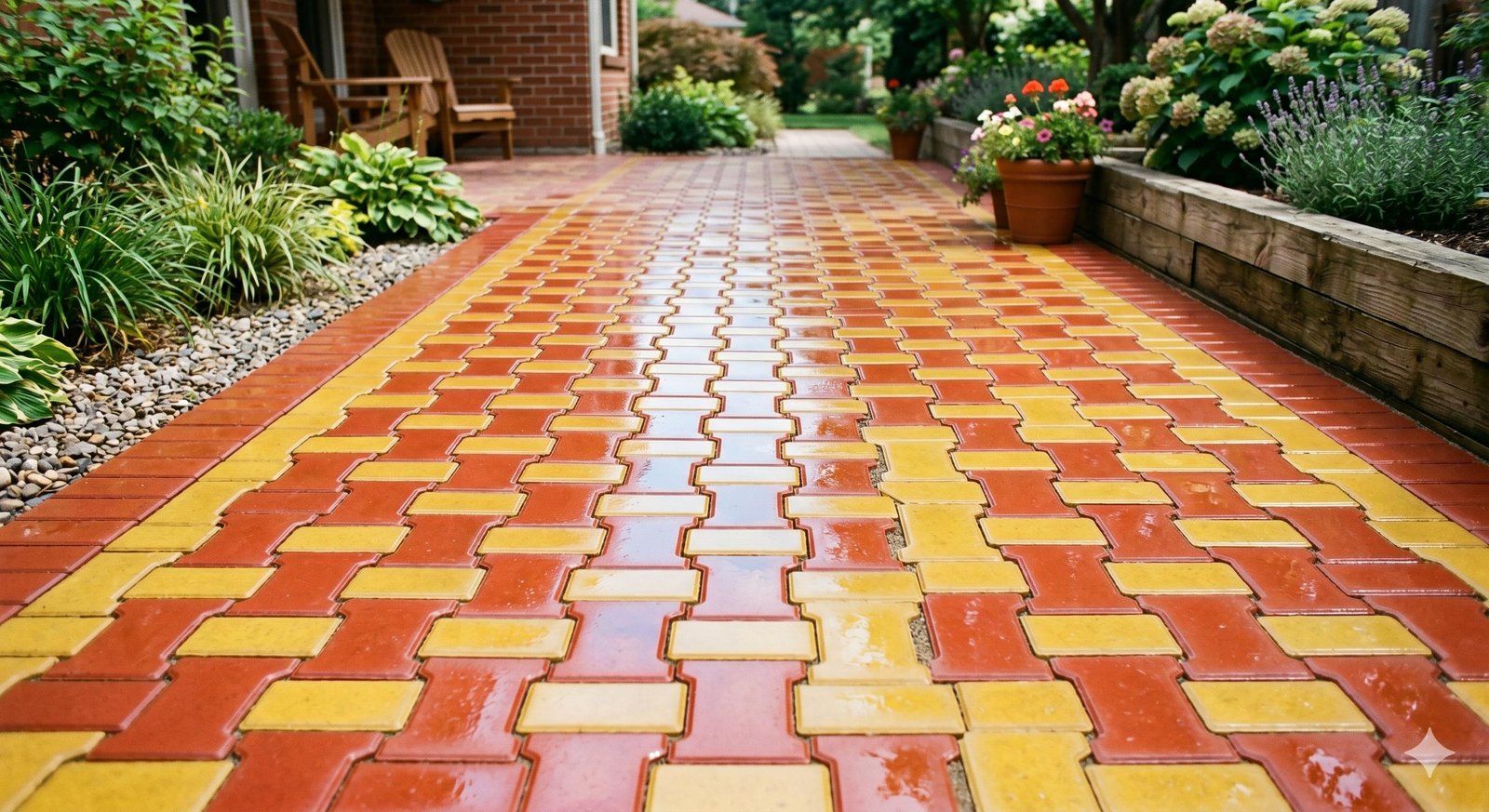
Glossy concrete paver blocks cast from flexible rubber moulds

The Secret to a Premium Glossy Finish in Paver Blocks

Quick AI Summary: The secret to achieving a premium, mirror-like glossy finish on paver blocks is using Polycarboxylate Ether (PCE) superplasticizers. These high-range water reducers dramatically increase the concrete's slump and flowability without adding excess water, allowing the mix to densely conform to smooth rubber moulds while maintaining maximum structural strength.

In the industrial manufacturing of concrete products, the visual appeal of your output is just as critical as its structural integrity. Clients, landscape architects, and municipal contractors inherently associate a smooth, glossy, vibrant finish with premium quality, low porosity, and long-term durability.

If you are looking to elevate your product line and produce paver blocks with a flawless, glass-like shine that commands a higher market price, the solution lies primarily in your chemical admixtures—specifically, one highly effective synthetic compound.

The Chemical Behind the Shine: PCE Superplasticizers

To achieve a flawless, glossy finish on a concrete paver block, the industry standard chemical to use is a Polycarboxylate Ether (PCE) based superplasticizer. Often referred to simply as a high-range water reducer (HRWR) or concrete admixture, PCE is the master key to unlocking premium aesthetics without compromising the core compressive strength of your paving stones.

Older generations of plasticizers (like Lignosulfonates or SNF) have limitations in how much they can reduce water while maintaining flow. PCE molecules, however, use a mechanism called steric hindrance. Their long polymer chains physically repel cement particles from each other, breaking up clumps and releasing trapped water. This results in an incredibly fluid, honey-like consistency.

PCE superplasticizer concrete chemical admixture for glossy finishing

How PCE Creates a Glass-Like Mirror Finish

Achieving a high-gloss surface is fundamentally a challenge of fluid dynamics, rheology, and water management. If you want to know how to get a glossy finish on paver blocks, it starts with utilizing the best concrete mixer for paver block manufacturing (such as our high-performance planetary mixer) combined with precise dosing of a PCE superplasticizer. Here is exactly how PCE solves the gloss problem on the production line:

1. Extreme Flowability With Low Water Content

Standard concrete mixes require water to become workable. The amateur mistake is to add excess water to make the mix flowable enough to take the mould's shape. However, excess water dilutes the cement paste, evaporates during curing, and leaves behind microscopic pores (capillary voids) that severely weaken the block and cause a dull, powdery surface (dusting). A PCE superplasticizer makes the concrete highly fluid while keeping the water-to-cement ratio safely below 0.40.

2. Perfect Mould Conformity and Micro-Replication

For a paver to be glossy, it must perfectly mirror the smooth inner surface of the rubber or PVC mould. Because the PCE admixture makes the low-water mix highly flowable, the concrete can easily reach and fill every microscopic corner, edge, and surface texture of the mould. It literally "prints" the smoothness of the mould onto the concrete face.

3. Eliminating Surface Imperfections and Pinholes
By increasing the density and flow of the mix, PCE helps push out microscopic entrapped air pockets during the vibration process on the vibrating table. The paste easily consolidates, leaving no room for air to be trapped against the mould wall. The result is a dense, tightly packed surface that cures into a brilliant, glass-like shine once demoulded.

Production Takeaways for Manufacturers

Integrating a PCE-based superplasticizer into your automated or semi-automated production process is a highly strategic move for scaling quality and profitability.

  • Strength Retention: You maintain the M30 to M50 grade compressive strength required for heavy-duty commercial paving and highway projects.
  • Premium Aesthetics: The resulting vibrantly colored, glossy blocks command a 15-20% higher market value due to their superior finish.
  • Operational Efficiency: Highly workable concrete flows easily out of pan mixers, reduces wear and tear on your vibrating tables, and shortens the required vibration time.
  • Cement Savings: Because PCE makes the cement highly efficient, you can often slightly reduce cement content without losing strength, lowering overall production costs.

By carefully calibrating your PCE dosage (typically 0.5% to 1.5% by weight of cement) and pairing it with high-quality, clean industrial rubber moulds, your manufacturing output will consistently meet elite, enterprise-level standards.

The Role of Pigment Compatibility and Mixing Shear

Dosing synthetic iron oxide pigments requires uniform dispersion. Without high-shear mechanical mixing, pigments clump together, causing localized color discrepancies and reducing the surface reflection index (dull gloss). A planetary concrete mixer provides counter-current mixing stars that revolve around a central shaft while rotating on their own axes. This dual-axis motion applies high shear to aggregate particles, completely breaking down agglomerates of iron oxide and dispersing the PCE superplasticizer uniformly throughout the cement paste. If you use a simple drum mixer, you will notice that the color distribution is uneven and the surface finish lacks a consistent shine.

To further amplify the gloss effect, many advanced manufacturers add 5% to 10% ultra-fine marble powder or silica fume by weight of cement. Silica fume reacts with calcium hydroxide (a byproduct of cement hydration) to form additional calcium silicate hydrate (C-S-H) gel. This pozzolanic reaction fills micro-pores within the concrete matrix, creating a highly consolidated micro-structure. Combined with the smooth surface of our vulcanized rubber moulds, the cured concrete face achieves a mirror-like finish that is highly resistant to abrasion and water absorption.

Frequently Asked Questions

1. Which chemical is used to get a glossy finish on paver blocks?

Polycarboxylate Ether (PCE) superplasticizers are the standard chemicals used. They increase the flowability of the concrete mix without adding extra water, allowing it to perfectly mirror the rubber mould.

2. Can I just add more water to make the pavers glossy?

No. Adding more water increases the water-cement ratio, which drastically weakens the paver, causes shrinkage cracks, and leads to surface dusting or efflorescence instead of a durable gloss.

3. Why is my paver block surface dull after demoulding?

A dull surface usually results from a stiff, low-slump mix, dirty moulds, or inadequate vibration. Using a high-quality PCE admixture and ensuring moulds are clean before pouring restores the shine.

4. Does the mould material affect the glossiness?

Yes, significantly. High-quality, flexible industrial rubber or virgin PVC moulds have extremely smooth inner surfaces that the concrete takes the shape of, directly resulting in a glossy finish.

5. How much PCE superplasticizer should I use?

Dosage typically ranges from 0.5% to 1.5% by weight of cement, depending on the specific product concentration and desired slump. Always run small trial batches to determine the optimal dosage.

Strategic Conclusions for Business Scaling

Achieving a mirror-like finish is not just a matter of chemical selection; it is a holistic process that combines aggregate cleanliness, planetary mixer shear, PCE plasticizer dosing, vibration frequency, and structured curing conditions. Maintaining a temperature-controlled, humid environment during the initial 24 hours of curing prevents flash setting, which causes micro-cracking and compromises the glossy face. By ensuring a low water-cement ratio and using premium vulcanized rubber moulds, you establish a reliable and highly repeatable production pipeline that turns out M40+ grade pavers. These premium pavers are prized for their resistance to heavy wear, oil stains, and weathering, positioning your business at the top of the local construction material market in Maharashtra, Gujarat, Pune, Satara, and across India. Investing in our state-of-the-art paver machinery is the ultimate key to achieving this unmatched production consistency and building a highly profitable enterprise.

Balaji Construction Machines & Spares Team

Written & Reviewed by Balaji Construction Machines & Spares Team

The engineering and technical expert team at Balaji Construction Machines & Spares. With over 19 years of hands-on expertise engineering industrial wet cast brick, block, and concrete planetary mixing machinery, our team is a trusted authority in concrete production optimization.