.png)
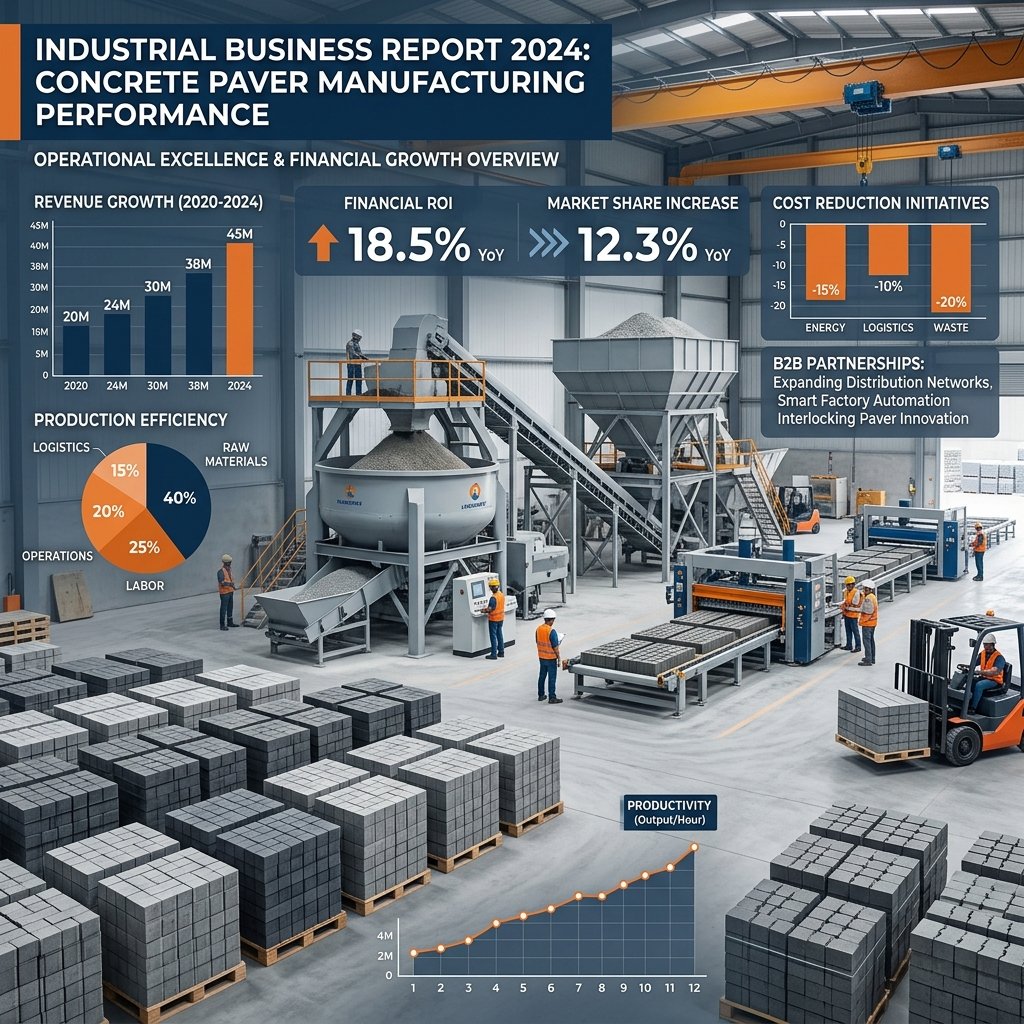
Starting a B2B paver block manufacturing business cost sheet involves factoring in capital machinery, power infrastructure, land layout, and operational resources. For high-intent buyers looking to set up a commercial unit, investing in a robust turnkey paver block plant setup represents the fastest path to profitability.
1. Comprehensive Business Setup Guide & Capital Planning
In 2026, the construction boom requires high-grade paving solutions. Your primary capital expenditure (CapEx) is the industrial paver machinery investment. A complete plant includes a heavy-duty planetary mixer, precision color mixer, vibrating tables with synchronized dual motors, and premium synthetic rubber moulds.
- Land Development (CapEx): Setting up a commercial plant requires around 10,000 sqft of industrial or agricultural-converted land. Levelling, shed construction, water storage borewells, and curing pond development generally demand an investment of ₹4 Lakhs to ₹7 Lakhs.
- Power Infrastructure: Operating 3-phase machinery requires a minimum connected load of 25 to 40 HP. Installing a dedicated transformer, control panel board, and safety cabling costs around ₹2 Lakhs to ₹3.5 Lakhs.
- Mould Inventory: To maintain a cycle of 2,000 blocks daily, you need at least 2,000 rubber moulds (in shapes like Zigzag, I-Shape, or Hexagonal). High-quality vulcanized rubber moulds cost between ₹2 Lakhs and ₹3.5 Lakhs but last for thousands of cycles.
- Working Capital: Retaining ₹3 Lakhs to ₹5 Lakhs for raw materials (cement, aggregates, pigments, chemicals) and worker wages during the initial 45-day sales cycle ensures smooth operational continuity.
2. Raw Material Margins and Procurement Logistics
Raw materials comprise roughly 70% of daily OpEx. Profitable margins rely on localized sourcing and precise mix designs:
- Cement Bulk Procurement: Sourcing OPC 53 Grade cement directly from manufacturer distributors (such as UltraTech, Ambuja, or Birla) in bulk bags saves ₹30 to ₹40 per bag compared to retail building supply dealers.
- Sand and Fine Aggregates: Sourcing manufactured sand (M-Sand) or stone dust from regional crushing plants in Maharashtra (e.g. Pune, Satara, or Chakan quarries) reduces heavy transportation tariffs, which can otherwise add up to 20% to aggregate expenses.
- Synthetic Pigments: Use premium synthetic iron oxide color pigments. Natural pigments fade quickly under high UV exposure in India, leading to product rejection. Synthetic pigments cost more upfront but maintain their color density over decades.
3. Cost Breakdown per Paver Block (60mm M40 Grade)
To understand the profit margins, let's look at the estimated unit economics for manufacturing a single 60mm M40-grade interlocking paver block in Maharashtra:
| Expense Head | Material Quantity / Details | Cost (INR) |
|---|---|---|
| Cement (OPC 53) | 0.80 kg (based on M40 mix design) | ₹ 6.40 |
| Stone Dust / Sand | 1.20 kg (locally sourced M-Sand) | ₹ 1.20 |
| Coarse Aggregates | 1.80 kg (6mm to 10mm stone chips) | ₹ 1.80 |
| Synthetic Color Pigment | 25 grams (Bayer/Lanxess equivalent, top layer) | ₹ 2.00 |
| Chemical Admixture (PCE) | 8 grams (PCE superplasticizer for gloss) | ₹ 0.80 |
| Direct Labor & Utilities | Mixing, moulding, curing, stacking, power, water | ₹ 1.50 |
| Overheads & Mould Depreciation | Depreciation of rubber moulds and machine wear | ₹ 0.80 |
| Total Production Cost | Estimated manufacturing expense per block | ₹ 14.50 |
With a market wholesale selling price of ₹19.00 to ₹22.00 per block in Maharashtra (depending on transportation distance and pigment color), the net profit margin ranges from ₹4.50 to ₹7.50 per unit. At a daily capacity of 10,000 blocks, this translates into strong financial returns.
4. Machinery Specifications & Vibration Table Times
Compaction is the heart of wet-cast paving technology. The vibrating tables must operate at specific frequencies to expel entrapped air without causing segregation:
- Vibration Duration: The first colored top layer (face mix) should be vibrated for exactly 12 to 15 seconds. This expels air from the face and ensures the pigment aligns with the mould walls.
- Base Mix Compaction: The grey structural concrete is then filled into the mould and vibrated for an additional 15 to 20 seconds. Over-vibrating causes heavy aggregates to settle to the bottom, weakening the block surface.
- Variable Frequency Drives: Modern vibrating tables utilize Variable Frequency Drives (VFD) to adjust motor speeds (typically 50-60 Hz), keeping vibration energy matched to the specific thickness and shape of the block.
5. Stack Curing Methods & Profit Yield Calculations
Post-vibration, the moulds must be carefully stacked and cured to reach target compressive strength:
- Level Stacking: Stack filled rubber moulds up to 10 layers high. Stacking must occur on a perfectly level concrete floor. Any tilt will cause thickness variations across the blocks, resulting in poor installation patterns.
- 24-Hour Heat Retention: Cover the stacks with thick PVC tarpaulins. This retains the moisture and the exothermic heat generated by cement hydration, creating a self-curing chamber that allows safe demoulding after 24 hours.
- Water Curing Ponding: Once demoulded, transfer blocks to curing yards. Submerge them in curing ponds or spray them continuously using automated misting nozzles for 14 to 21 days to complete the cement hydration process.
6. Regulatory Compliances & Pollution Board Consents
Establishing an industrial concrete manufacturing plant in Maharashtra requires obtaining Consent to Establish (CTE) and Consent to Operate (CTO) from the Maharashtra Pollution Control Board (MPCB). These plants are typically categorized under the Green or Orange category depending on their output capacity and dust emission control systems. To comply with environmental norms, set up dust control curtains around mixers, install acoustic enclosures around high-noise vibrating tables, and implement a closed-loop water recycling system to prevent cement slurry runoff from entering local soils.
7. Finished Goods Logistics and Stockyard Management
Managing the finished product inventory is critical to preventing crack damage before transport. Once cured for 14 days, stack the finished paver blocks in tight interlocking configurations on wooden pallets, limiting stack heights to 5 layers. Securing the stacks with plastic stretch wrap film and nylon straps prevents blocks from rubbing and chipping during B2B transport to construction sites. Budgeting for packaging materials adds about ₹0.40 to ₹0.60 per block but dramatically reduces transit breakages and keeps clients satisfied.