.png)
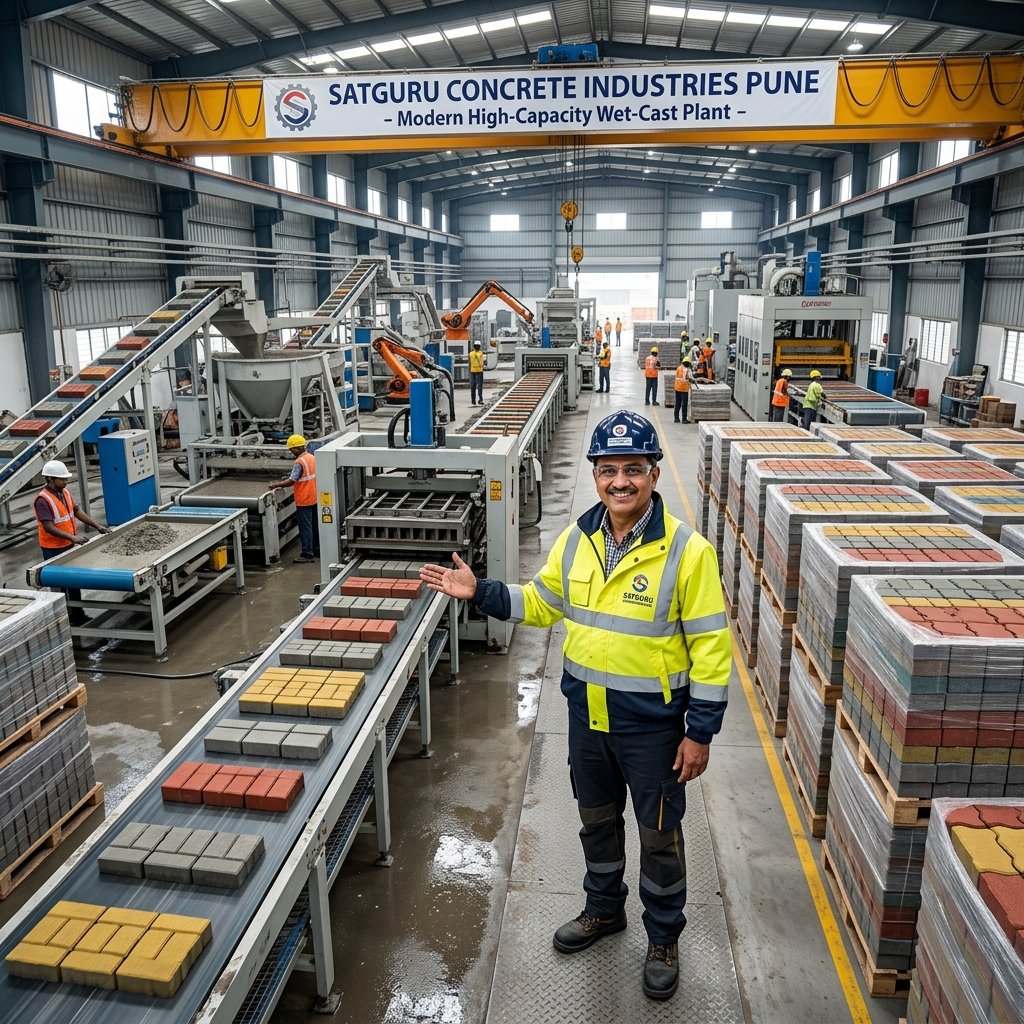
Scaling a concrete block manufacturing unit requires a strategic shift from labor-intensive processes to streamlined automation. This case study explores how Pune Concrete Products, a leading supplier in Maharashtra, increased production by 40% by transitioning to a Balaji automated turnkey paver plant.
1. The Bottleneck: Manual Operations
Pune Concrete Products operates in the highly competitive Pune-Chakan-Talegaon industrial belt in Maharashtra, where construction developers and infrastructure contractors demand high-strength M30 to M50 grade concrete paver blocks. To meet this demand, the client initially operated a semi-automatic production setup. However, they hit a severe growth ceiling due to several critical operational bottlenecks:
- High Labor Dependency and Absenteeism: The manual batching and demoulding processes required a large team of 15+ unskilled laborers. In India, particularly during the festive season (Diwali, Holi) and the peak summer and monsoon agricultural sowing periods, labor shortages are acute. Pune Concrete Products suffered from frequent work stoppages, making it impossible to schedule reliable daily production shifts.
- Inconsistent Mix Consistency and Low Strengths: Aggregates (sand, crushed stone dust, and cement) were measured manually using iron pans (gamelas) and wheelbarrows. Because moisture levels in the sand fluctuated daily based on humidity and storage conditions, workers added water arbitrarily "by sight." This led to fluctuating water-to-cement ratios, resulting in uneven compressive strengths (blocks failing to reach the M40 spec during load testing) and high reject rates.
- Manual Demoulding Handling Failures: The freshly cast blocks were demoulded by hand. Unskilled workers often dropped or improperly stacked the fragile, green blocks, causing chipped edges, surface cracks, and corner breakage. This manual handling led to a structural rejection rate of 8% to 10% of their total daily production.
- Output Limit: Daily output was strictly capped at 12,000 blocks per 12-hour shift, despite high market demand, which meant they had to turn down lucrative municipal road and warehouse flooring orders.
2. Implementing Automated Inline Systems
To eliminate these bottlenecks, Balaji Construction Machines engineered and installed a customized, turnkey fully automatic paver block plant. The heart of the new automation lay in the electronic inline batching and conveyor systems:
- Three-Bin Inline Aggregate Batcher: We replaced manual aggregate measuring with a heavy-duty three-bin inline batching system. Each bin is dedicated to a specific aggregate size (stone chips, washed river sand/stone dust, and coarse gravel). Below the bins, a high-precision digital weighing conveyor belt is suspended on electronic load cells.
- PLC Recipe Management: The plant operator inputs the exact concrete mix design (e.g., M40 or M50 recipe) into the Centralized PLC Control Panel (featuring a Siemens/Schneider HMI touchscreen). The PLC automatically regulates the pneumatic discharge gates of the aggregate bins, dispensing the exact weight of each material within a margin of error of less than 1%.
- Automatic Screw Conveyor and Chevron Belt: Bulk cement is stored in a 50-ton steel silo and fed directly into the mixer using a motorized screw conveyor. A high-speed chevron-cleated conveyor belt lifts the precisely weighed aggregates directly into the charging port of the planetary mixer, creating a continuous, automated material flow that cuts batch loading times from 5 minutes to just 45 seconds.
3. The Role of the Planetary Mixer and Auto-Ejection
Mixing concrete for high-quality rubber mould pavers is significantly different from standard structural concrete. It requires a low water-cement ratio mixed with PCE superplasticizers and iron oxide pigments. To achieve this, the plant features Balaji's advanced Planetary Mixer and automated ejection technology:
- Planetary vs. Pan Mixing Action: Traditional pan mixers use fixed-axis paddle arms that leave dead zones and require up to 6 minutes to achieve a decent mix. The Balaji Planetary Mixer features counter-current mixing stars that rotate on their own vertical axis while simultaneously revolving around the central mixing pan. This multi-dimensional action ensures that cement particles, aggregates, color pigments, and water are subjected to intense mechanical shear. The water and PCE superplasticizers are distributed uniformly in just 150 seconds, ensuring no pigment clumping or dry spots.
- Vibrant Top Color Layer Mix: For rubber mould pavers, a double-layer process is used. The top layer (face mix) contains synthetic iron oxide pigments. The planetary mixer's homogeneous blending action ensures that the pigment particles coat every aggregate grain, resulting in a vibrant, fade-resistant color finish with no streaks or shade variations.
- Automated Mould Feeding and Compaction: The flexible rubber moulds are loaded onto a synchronized conveyor belt. An automatic feeding station fills the moulds with the colored face mix, followed by the grey base concrete mix. The filled moulds move onto a high-frequency vibrating table equipped with variable speed drives. The vibration expels all entrapped air bubbles, ensuring the concrete conforms to the mould surface to produce a smooth, glass-like finish.
- Pneumatic Auto-Ejection Station: Rather than workers hand-hitting the moulds to release the blocks, an automated demoulding station uses soft pneumatic actuators and vacuum suction to extract the cured paver blocks from the rubber moulds. The blocks are placed gently on heavy-duty wooden pallets. This eliminates demoulding micro-cracks, bringing handling rejects down to zero.
4. Streamlining Stack Curing & Yield Enhancement
Curing is where the concrete gains its final strength. In the manual setup, workers carried individual moulds across the yard, leading to uneven curing and space wastage. The automated plant streamlined curing logistics:
- Pallet Stackers and Vertical Curing: The demoulded paver blocks on wooden pallets are automatically fed into a mechanical stacker. The stacker groups the pallets vertically (up to 10 layers high). A single operator using a heavy-duty forklift then moves the entire stack of 10 pallets into the curing chambers. This vertical stacking system optimized yard space utilization by over 300%.
- Micro-Mist Hydration Chambers: The curing chambers are equipped with automated high-pressure micro-mist sprinkler lines. Instead of flooding the blocks with a hose (which can leach out color pigments and cause efflorescence), the micro-mist system maintains a constant relative humidity of 95% at an optimal temperature of 28°C.
- Yield Optimization: This controlled humidity hydration ensures the rapid development of calcium silicate hydrate (C-S-H) gel, accelerating strength gain. Because the blocks are not moved individually during the first critical 24 hours of hydration, edge chipping is eliminated. The overall reject rate dropped from 8% to under 1.5%, significantly boosting the daily saleable yield of premium pavers.
5. The Result: 40% Increase in Output and Faster ROI
The integration of Balaji's fully automatic plant transformed Pune Concrete Products' business model, driving high output, superior margins, and a rapid return on investment:
- Production and Labor Metrics: Daily output surged from 12,000 blocks to over 17,000 blocks per shift, representing a 41.6% increase in production capacity. The operational staff was reduced from 15 manual laborers to just 6 skilled operators (1 PLC programmer, 1 forklift driver, and 4 packaging/stacking assistants), representing a 60% reduction in labor overhead.
- Securing High-Margin Contracts: Thanks to the automated batching, the compressive strength of the pavers remained consistently above 40 MPa (M40 grade). This consistency enabled Pune Concrete Products to pass stringent government lab tests, allowing them to secure lucrative contracts for the Pune Metro project, municipal sidewalk paving, and heavy-duty container yard flooring.
- Financial Return on Investment (ROI):
- Labor Savings: Saving 9 workers' wages at Rs. 450/day equals Rs. 4,050 daily or Rs. 1,05,300 per month.
- Material Savings: Automated batching eliminated raw material wastage (aggregates and cement) by 5%, saving Rs. 80,000 per month.
- Wastage Reduction: Lowering the reject rate from 8% to 1.5% saved Rs. 65,000 per month in raw material costs.
- Increased Revenue: The additional 5,000 blocks produced daily generated a net profit margin of Rs. 2 per block, amounting to Rs. 10,000 daily or Rs. 2,60,000 per month.
- Total Monthly Gain: Rs. 5,10,300.
Operational Comparison: Manual vs. Fully Automatic Plant
| Operational Metric | Before (Manual Setup) | After (Balaji Automatic Plant) |
|---|---|---|
| Daily Production Volume | 12,000 blocks / shift | 17,000+ blocks / shift (+41.6%) |
| Labor Dependency | 15+ unskilled workers | 6 operators (-60% labor dependency) |
| Block Compressive Strength | Variable (Frequent test failures) | Consistent M40 / M50 (Passed load tests) |
| Material Batching Precision | Manual/Volumetric (high error) | Automatic/Load Cell weighing (1% error margin) |
| Curing Handling Rejections | 8.0% to 10.0% | Less than 1.5% |
| Planetary Mixing Cycle Time | 7.0 minutes per batch | 2.5 minutes per batch (-64.2%) |