.png)
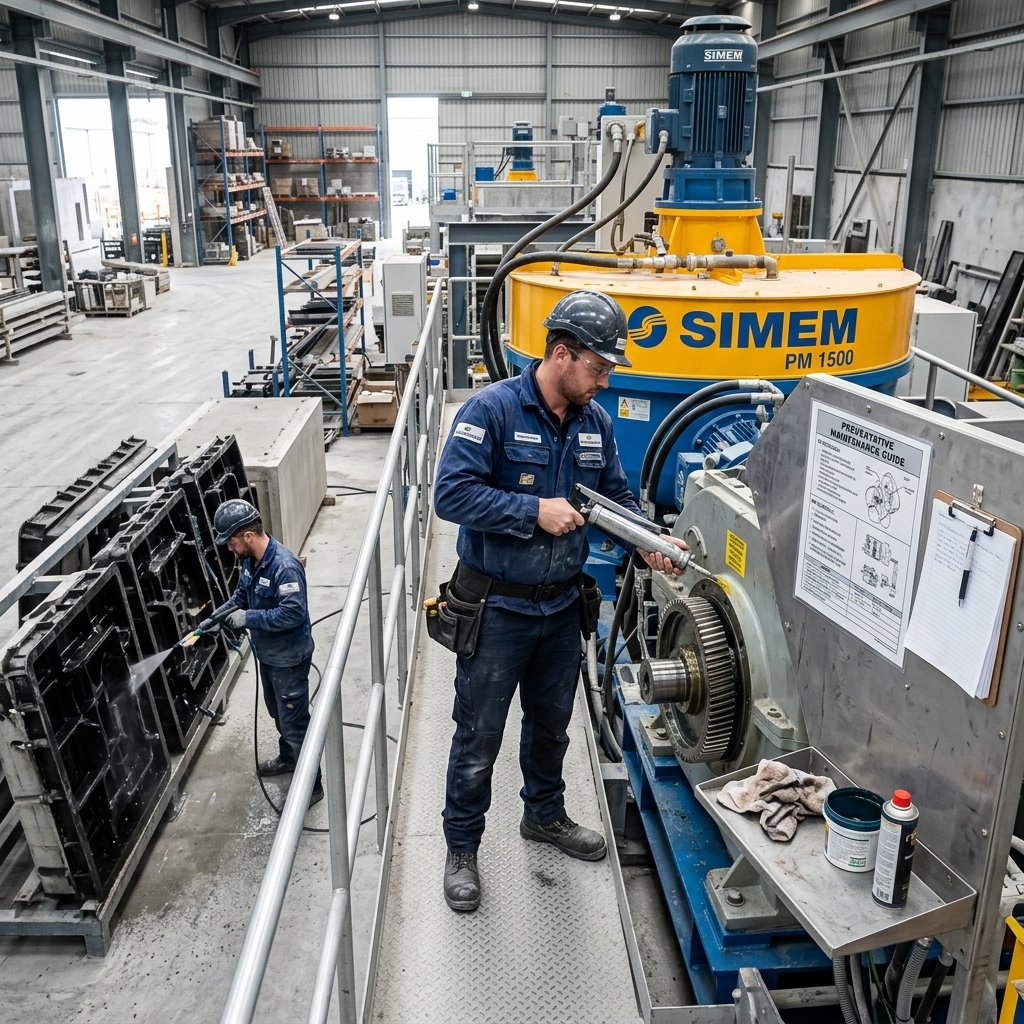
Maintaining industrial concrete production equipment goes far beyond simple routine lubrication and basic oil changes. For regional manufacturers looking to extend paver block machines lifespan and maximize plant operating margins, implementing a highly structured, proactive maintenance checklist is the single most effective way to minimize production downtime and avoid expensive spare parts replacements. The highly abrasive nature of concrete mix components takes a heavy daily toll on planetary mixers, vibrating tables, pneumatic cylinders, and synthetic rubber moulds. Here are the comprehensive, engineering-backed strategies for equipment preservation.
1. Planetary Mixer Wear Management
The planetary mixer is the powerhouse of the wet-cast process, but it faces severe abrasion from aggregates. To mitigate wear, regional operators in Maharashtra should establish these maintenance routines:
- Adjust Blade Clearances: Inspect and adjust the clearance between the mixing blades and the floor liners weekly. The gap must be kept between 2mm and 4mm. If the gap is too large, aggregates wedge between the blade and the liner, causing friction hotspots, high motor load, and scoring.
- Planetary Gearbox Lubrication: Use high-performance industrial gear oil (ISO VG 220 or 320), check oil levels daily, and perform a complete oil change every 1,500 hours. Grease the output shaft bearings every 50 hours of operation to prevent dust ingress.
- Daily Wash Routine: Flush the mixing drum with high-pressure water jets and use non-sparking brass scrapers to remove any hardened residue after every shift. Dried concrete buildup accelerates blade erosion and strains the planetary motor.
2. Rubber Mould UV Preservation and Storage
Synthetic rubber moulds represent a significant recurring investment. Prolonging their life directly boosts profitability:
- UV Protection: Synthetic elastomeric rubber is highly sensitive to ultraviolet (UV) radiation. Extended exposure to sunlight causes dry rot, micro-cracks, and loss of flexibility. Store all moulds in a shaded, well-ventilated warehouse.
- Flat Stacking: Stack moulds flat, nested bottom-to-bottom and top-to-top. Stacking them haphazardly deforms the elastomeric side walls, leading to dimensional inaccuracies in the finished pavers.
- Height Limits: Limit stack heights to 15 layers. If stacking higher, place plywood dividers between sections to distribute the weight evenly and prevent bottom moulds from compressing permanently.
3. Mold Cleaning and Acid Washing Protocols
Cement scaling in the micro-crevices of rubber moulds destroys the glossy finish of paver blocks over time:
- Acid Wash Schedule: Perform a mild acid wash (using a 5% to 10% solution of dilute hydrochloric acid in water) every 15-20 days. Ensure you always add acid to water, never water to acid, to prevent splashing.
- neutralization Bath: Submerge the moulds in the acid bath for no longer than 8 to 12 minutes. Immediately transfer the moulds to a fresh water neutralizing bath and use a pressure washer to remove all softened concrete residue.
- Avoid Chemical Attacks: Do not leave moulds in the acid bath overnight, as the acid will chemically attack the rubber polymer chains, leading to surface pitting and premature tearing.
4. Release Oil Application & Admixture Chemistry
While rubber moulds have natural release properties, complex geometric profiles may occasionally require a release agent:
- Avoid Petroleum Lubricants: Never use diesel, burnt engine oil, or petroleum-based release agents. The hydrocarbons in petroleum chemically attack rubber, causing the moulds to swell, warp, and lose detail.
- Use Silicone Emulsions: If a release agent is necessary, use specialized water-soluble silicone emulsions applied in a very thin, atomized mist using a spray gun. Wipe off any excess oil pools with a clean microfiber cloth.
- Control Admixture Dosage: Over-dosing superplasticizers creates a sticky, high-viscosity concrete paste. This paste clings to the mould details, forcing workers to hammer or bend the moulds violently during demoulding, which tears the rubber.
5. Vibrating Table and Pallet Maintenance
Vibrating tables undergo immense stress and cyclic loading during concrete compaction:
- Spring and Rubber Mounts: Inspect the steel springs or rubber isolating mounts weekly for fatigue or cracks. A collapsed spring throws the table off-balance, creating uneven compaction and causing aggregate segregation.
- Vibratory Motor Synchronization: Ensure the unbalance weights on the dual-shaft vibratory motors are precisely synchronized. If the motor weights get out of sync, the table will vibrate horizontally rather than vertically, trapping air inside the block.
- Foundation Bolts: Tighten all frame and motor foundation bolts daily. High-frequency vibration (3000-3600 RPM) can loosen heavy-duty bolts, which can lead to structural frame fractures.
6. Hydraulic Power Pack Maintenance
Turnkey fully automatic plants and semi-automatic demoulding presses rely heavily on hydraulic power packs to drive aggregate gates and eject pallets. To ensure hydraulic system longevity: check the hydraulic oil level daily; maintain the fluid temperature below 55°C (131°F) using heat exchangers to prevent chemical degradation of seals and O-rings; and change the oil return line filter cartridge every 500 operational hours. Perform a complete fluid replacement with ISO VG 46 or 68 hydraulic oil annually, flushing the reservoir tank to remove metallic micro-particles. In addition to oil changes, clean the suction strainer screen inside the reservoir every 6 months to prevent pump cavitation and wear.
7. Pneumatic System and Air Compressor Care
Pneumatic valves, solenoid cylinders, and air batching gates are highly sensitive to moisture and particulate contamination. Maintain your FRL (Filter, Regulator, Lubricator) units daily. Ensure the oil reservoir in the lubricator is filled with light pneumatic tool oil (ISO VG 32) to lubricate cylinder seals automatically. Drain condensation water from the air receiver tank daily to prevent rust formation inside solenoid valves. Replace air compressor intake filters every 3 months to prevent fine aggregate dust from entering the cylinders and scoring the pistons. Verify that system pressure is set strictly between 6 to 8 bar to prevent mechanical fatigue on batching gates.